A few days after arriving in Canada, my brother found me putting all our household garbage into one black bin.
He stopped me and started separating the waste.
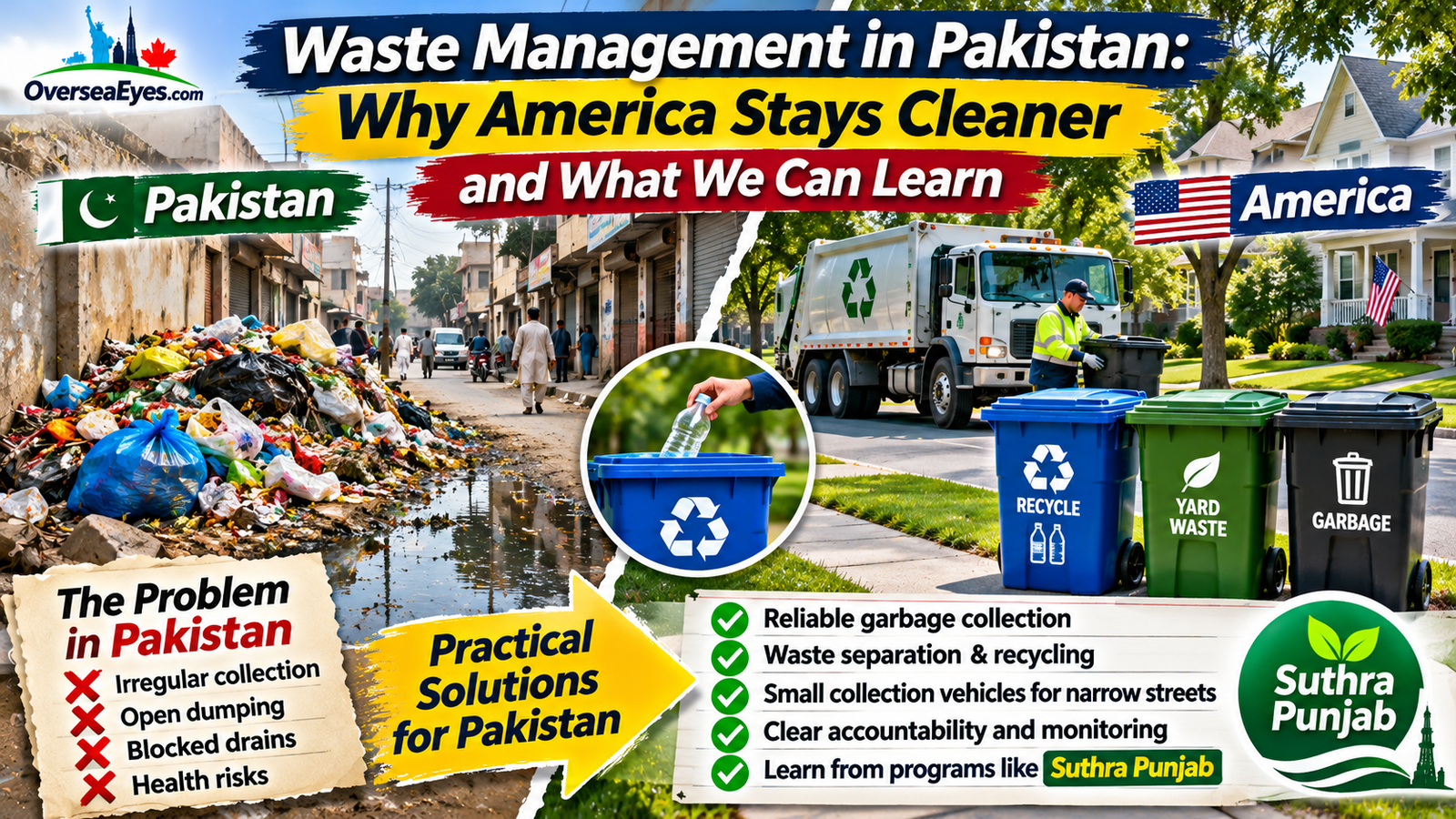
Plastic and glass went into one bin. Paper and cardboard went into another. Ordinary household garbage went into the third.
I wondered why something as simple as throwing away garbage required so much attention.
Every Thursday, the garbage was collected from our house according to an established schedule.
Nobody had to search for an empty plot to dispose of their rubbish. Nobody had to wait for a government cleanliness campaign.
It was simply part of everyday life.
A few years later, during a visit to Pakistan, I experienced something completely different.
As we were travelling near Islamabad, a terrible smell entered our vehicle. Large amounts of garbage had been dumped in the open beside the road.
This was the capital of Pakistan.
Two experiences. Two different systems. And one question that has stayed with me ever since.
Why can’t waste management in Pakistan become as reliable as the system I experienced in North America?
1. How Serious Is Pakistan’s Waste Management Problem?
According to a report published by the U.S. International Trade Administration in February 2026, Pakistan generates approximately 50.79 million tons of solid waste annually.
The report estimates that urban collection services recover around 60 to 70 percent of the garbage generated in cities.
The remaining waste is a serious concern.
Some is recovered informally for recycling. Some may remain uncollected, accumulate in open areas or be disposed of improperly.
The report also provides estimated daily waste generation figures for several major Pakistani cities.
| City | Estimated daily waste generation |
|---|---|
| Karachi | 17,000 tons |
| Lahore | 7,800 tons |
| Faisalabad | 5,100 tons |
| Rawalpindi | 4,600 tons |
| Multan | 3,700 tons |
| Peshawar | 2,200 tons |
| Quetta | 1,600 tons |
These are estimates based on domestic trade and industry information rather than exact daily measurements.
Source: U.S. International Trade Administration – Pakistan Waste Management
Now imagine trying to manage thousands of tons of garbage every day without sufficient collection vehicles, dependable schedules and adequate disposal facilities.
The problem becomes much easier to understand.
Pakistan’s garbage crisis is not simply about people throwing rubbish on the streets. It is also about what happens before and after they throw it away.
2. The Islamabad Experience I Still Remember
It was around 2013 or 2014 when I experienced that unpleasant smell near Islamabad.
I had already spent time living abroad. Perhaps that made the contrast more noticeable.
What bothered me was not just the garbage.
It was the location.
Islamabad is Pakistan’s capital. It represents the country to foreign visitors, businesspeople and diplomats.
Yet there we were, passing an area where garbage had accumulated in the open.
I had observed similar problems in Lahore, Karachi and Peshawar.
Over time, people can become accustomed to such conditions. A pile of garbage that would once have attracted attention slowly becomes part of the surroundings.
But becoming accustomed to a problem does not make it acceptable.
Every child growing up in Pakistan deserves to believe that clean streets are normal.
Cleanliness should not be something Pakistanis experience only when they travel abroad.
3. How Garbage Collection Works in America
When I moved to the United States, I noticed that garbage collection was treated as an essential household service.
In many American suburban communities, residents are provided with designated containers and a collection schedule.
The system is straightforward.
Household garbage
Ordinary non-recyclable household waste is placed in a designated container.
Recyclable materials
Accepted paper, cardboard, plastic containers and metal cans are collected separately.
The exact list of accepted materials varies according to local recycling rules.
Yard waste
Grass clippings, leaves and other accepted garden waste may be collected through seasonal programs.
Special waste
Electronics, batteries, hazardous chemicals and certain large household items may require separate collection or designated drop-off locations.
For example, Hoffman Estates, Illinois, has an agreement with a private waste collection company to provide residential garbage and recycling services.
Residents have access to regular collection, seasonal yard waste services and special disposal arrangements.
Source: Village of Hoffman Estates – Garbage and Recycling Services
What makes this arrangement useful is its predictability.
Residents know what they are expected to do. They know when collection takes place and whom to contact if a problem occurs.
The local authorities also have a service provider responsible for carrying out the work.
A clean neighborhood is the result of an organized relationship between residents, municipal authorities and waste collection companies.
4. Does America Have a Perfect Waste Management System?
No.
Clean streets do not necessarily mean that a country produces less garbage.
According to the U.S. Environmental Protection Agency, the United States generated 292.4 million short tons of municipal solid waste in 2018.
Approximately 32.1 percent was recycled or composted, while around half went to landfills.
Source: U.S. Environmental Protection Agency – National Waste and Recycling Statistics
These are historical figures for 2018, not estimates of current 2026 waste generation.
America continues to face environmental challenges involving excessive consumption, plastic pollution, landfill capacity and recycling contamination.
There are also communities where waste services are inadequate.
Pakistan should not copy America’s consumption habits.
Instead, it should learn from the systems that make collection, transportation and responsible disposal more dependable.
A country should aim to produce less waste, recover useful materials and safely manage whatever remains.
5. Why Garbage Becomes a Bigger Problem in Pakistan
Several factors contribute to Pakistan’s waste management difficulties.
Unreliable garbage collection
When residents cannot depend on regular collection, waste may accumulate outside houses or in shared public spaces.
Inadequate public containers
Some neighborhoods lack conveniently located, properly maintained containers.
Even responsible citizens can struggle to dispose of waste when suitable facilities are unavailable.
Narrow residential streets
Many older Pakistani neighborhoods have streets that large collection vehicles cannot easily enter.
A collection system designed for wide American suburban roads may not work in these locations.
Limited household waste separation
When food scraps, plastic, paper and hazardous materials are mixed together, recovering useful materials becomes more difficult.
Weak accountability
Residents need to know which organization is responsible for collecting their garbage and what to do when collection does not occur.
Without clear responsibility, complaints can remain unresolved.
Public behavior
Some people throw rubbish from vehicles, dump household garbage in empty plots or discard plastic bags into drainage channels.
These actions create problems for everyone.
However, blaming citizens alone is not enough. Authorities must also provide realistic alternatives and dependable services.
6. Garbage Is Not Just an Environmental Problem
Imagine a pile of garbage outside a school.
Children pass it every morning. Flies gather around exposed food waste. Rainwater collects inside discarded containers.
Nearby residents eventually begin burning the garbage because it has not been collected.
What began as a collection failure has now become a public health concern.
Poorly managed waste can contribute to several problems.
Urban flooding
Discarded plastic and other rubbish can block drainage channels.
During heavy rainfall, these obstructions can contribute to water accumulating on streets and entering buildings.
I have discussed this issue in greater detail in my article on urban flooding in Pakistan and lessons from Chicago.
Public health risks
Standing water in discarded containers can provide breeding sites for mosquitoes. Poor sanitation and contaminated water can also increase exposure to infectious diseases.
Air pollution
Burning mixed garbage can release harmful smoke and pollutants.
The problem is particularly concerning when plastics and other synthetic materials are burned in residential areas.
Economic losses
Dirty surroundings can make commercial areas less attractive. Flooding caused partly by blocked drainage can damage vehicles, shops and homes.
Waste management is therefore not simply about making streets look attractive.
It is about protecting health, property and economic activity.
7. Can Pakistan Turn Garbage Into Something Valuable?
While living in Canada, I became interested in the idea of converting waste into useful products.
Edmonton experimented with a waste-to-biofuels facility operated by Enerkem. The project was designed to convert certain non-recyclable materials into fuels and chemicals.
It was an ambitious idea.
However, in January 2024, Enerkem announced that it was retiring the Edmonton facility.
Source: Enerkem – Edmonton Biofuels Facility Retirement Announcement
This is an important lesson for Pakistan.
Advanced waste processing technology can offer opportunities, but expensive projects do not automatically guarantee commercial success.
Pakistan should begin by recovering materials that already have practical uses.
| Waste material | Potential use |
|---|---|
| Food scraps | Compost or biogas |
| Garden waste | Compost |
| Paper and cardboard | Recycled paper products |
| Plastic | Suitable recycled products |
| Metal | Recovery and industrial reuse |
| Glass | Recycling where facilities exist |
Not every material can be recycled economically or safely.
Waste-to-energy projects also require careful evaluation of costs, pollution controls, waste composition and long-term operating conditions.
The priority should be reducing unnecessary waste and recovering useful materials before sending the remainder for safe treatment or disposal.
8. Suthra Punjab: Is Pakistan Already Moving in the Right Direction?
When I originally wrote about Pakistan’s garbage problem, I wanted to see more organized local collection and clear accountability.
An important development is the Suthra Punjab program.
According to its official website, the program aims to improve sanitation through coordinated collection services, monitoring, contractor supervision and public complaint channels.
Residents can also report cleanliness-related problems through the official platform or by calling the helpline at 1139.
Source: Government of Punjab – Suthra Punjab Program
This is the kind of institutional approach that Pakistan needs to examine and strengthen.
However, the success of a cleanliness program should not be measured only by announcements, the number of vehicles purchased or photographs of streets after a cleanup.
It should be measured by everyday results.
Are households receiving dependable collection?
Are complaints being resolved?
Are sanitation workers receiving appropriate protection?
Is the collected waste being processed or disposed of safely?
Are neighborhoods remaining clean months after the initial campaign?
These are the questions that determine whether a program creates lasting change.
Pakistan deserves recognition when it makes progress. It also deserves honest evaluation when improvements are needed.
9. My Simple Solution for Pakistan’s Narrow Streets
Whenever I discuss American garbage collection with people in Pakistan, someone raises a valid objection.
Our streets are different.
In many neighborhoods, a large American-style garbage truck would struggle to enter the residential lanes.
So why should Pakistan attempt to copy the same collection method?
Instead, imagine a collection system designed around the existing layout of Pakistani neighborhoods.
Step 1: Shared neighborhood containers
Where suitable space exists, a small group of eight to ten households could use designated, covered waste containers.
In areas without adequate space, workers could collect waste directly from households.
Step 2: Small collection vehicles
Compact electric vehicles, cargo tricycles or other suitable equipment could collect waste from narrow streets.
Step 3: Designated transfer locations
Waste could be moved to properly managed collection points accessible to larger municipal vehicles.
These locations would require frequent collection, cleaning and careful placement away from sensitive areas.
Step 4: Scheduled municipal transportation
Larger vehicles could transport the collected waste to sorting facilities, composting centers or authorized disposal sites.
Step 5: Gradual waste separation
Once regular collection becomes reliable, households could begin separating organic waste, recyclables and residual garbage.
The number of containers should depend on household density, waste volume and available collection frequency.
This is a proposed model, not a claim that one design will work everywhere.
Individual neighborhoods should test the approach, measure results and make adjustments before expanding it.
Pakistan does not necessarily need expensive imported equipment to begin improving its streets.
It needs collection systems that work with its own urban conditions.
10. What Pakistan Can Learn From America and Canada
| Area | North American practices | Opportunities for Pakistan |
|---|---|---|
| Garbage collection | Scheduled residential collection | Reliable neighborhood schedules |
| Waste separation | Designated containers | Gradual household sorting |
| Collection vehicles | Specialized trucks | Small vehicles for narrow streets |
| Recycling | Dedicated sorting facilities | Expand local material recovery |
| Public complaints | Identifiable service providers | Accessible complaint tracking |
| Disposal | Regulated facilities | Safer, engineered disposal sites |
| Worker protection | Occupational safety procedures | Protective equipment and training |
Pakistan should also recognize the contribution of informal waste collectors who recover recyclable materials.
Rather than ignoring these workers, municipalities could explore ways to provide safer working conditions, formal employment opportunities and access to organized recycling programs.
A successful waste management system should protect both the environment and the people who keep it clean.
11. Seven Practical Steps Toward a Cleaner Pakistan
Guarantee dependable garbage collection
Every neighborhood should have a clearly communicated collection schedule suited to local conditions.
Provide accessible containers
Covered containers and suitable collection points should be provided where needed, with regular cleaning and maintenance.
Introduce waste separation gradually
Begin with pilot neighborhoods and expand only when collection and recycling facilities can handle separated waste properly.
Strengthen municipal accountability
Publish collection coverage, complaint resolution times and contractor performance.
Protect sanitation workers
Provide gloves, suitable footwear, safety training and appropriate equipment.
Nobody should have to risk their health simply because their job involves keeping other people’s surroundings clean.
Educate children and adults
Schools, community organizations and public campaigns should teach responsible waste disposal through practical examples.
Enforce anti-dumping regulations fairly
Once residents have access to dependable disposal services, authorities should enforce regulations against illegal dumping consistently.
The objective should be cleaner communities, not simply increased revenue from fines.
These improvements are also connected to the wider social challenges discussed in my article on five major social issues in Pakistan and their solutions.
Frequently Asked Questions
What are the main waste management problems in Pakistan?
Major challenges include inadequate collection coverage, open dumping, limited waste separation, insufficient disposal infrastructure and inconsistent municipal services.
How much solid waste does Pakistan generate annually?
A February 2026 U.S. International Trade Administration report estimates that Pakistan generates approximately 50.79 million tons of solid waste annually.
Why are American neighborhoods generally cleaner?
Many American communities have scheduled garbage collection, designated containers, established disposal facilities and clearly defined responsibilities for residents and service providers.
Can Pakistan introduce household recycling?
Yes. Pakistan can introduce recycling gradually through neighborhood pilot programs, separate collection and investment in material recovery facilities.
What is the Suthra Punjab program?
It is a Punjab government sanitation initiative focused on improving garbage collection, public cleanliness, service monitoring and complaint resolution.
How can ordinary Pakistanis help keep their cities clean?
Citizens can avoid littering, use designated collection facilities, reduce unnecessary waste, separate recyclable materials where services exist and report illegal dumping.
Final Thoughts: Clean Streets Should Not Be a Luxury
I often think about those three garbage bins outside our house in Canada.
At the time, separating garbage seemed like an unnecessary extra task.
Today, I understand what that small routine represented.
A household understood its responsibilities. A collection company understood its responsibilities. The local authorities had a system to supervise the service.
Each part of the system had a role.
I also remember the smell near Islamabad during my visit to Pakistan.
I would love to return one day and drive through the same area without experiencing that smell again.
Not because someone arranged a special cleanup before an important visitor arrived.
Not because a cleanliness campaign was taking place.
But because collecting and managing garbage had become an ordinary, dependable part of daily life.
Pakistan does not need to become America or Canada.
It needs to become a Pakistan where children can walk to school without passing piles of garbage.
Where sanitation workers receive respect.
Where rainwater flows through drains instead of carrying rubbish through residential streets.
And where people take as much pride in keeping their neighborhood clean as they do in keeping their own homes clean.
We clean our houses every day. Why shouldn’t we expect the same cleanliness outside our front doors?
Does your neighborhood in Pakistan have reliable garbage collection? What is the biggest problem you experience?
Share your thoughts in the comments below.
Because if America and Canada can stay clean — so can we.






1 thought on “Waste Management in Pakistan: Why America Stays Cleaner and What We Can Learn”